About The Author:

"Roger, The Wine Guy" is Roger Yazell, CWS. He is a member of the International Wine Guild and has had a long time admiration of wine. After careers in broadcasting, advertising and marketing account management, he explored his love of wine in hospitality, wholesale and retail sales. The intent of Roger's Grapevine is to share stories, history and information that will add to the reader's love, enjoyment and appreciation of wine and sake'.

Questions, requests for topics and comments are always welcome via email: rogerthewineguy@gmail.com.

(Note: The Wine Guy is currently undergoing chemotherapy and this blog will be on hiatus for the duration and into a recovery period. The Wine Guy is planning to celebrate his recovery with a trip to the two wine producing regions in Argentina and that should provide for some interesting new blogs. Meanwhile please enjoy the archives and feel free to email in the interim.)
Showing posts with label Syrah. Show all posts

Friday, October 22, 2010

Chateauneuf du Pape

Chateauneuf du Pape is a wine worth exploring for its history as well as what it has to offer in taste.
This French AOC, comprising almost 7,500 acres of vineyards, is located in the southern Rhone Valley.  It is probably one of the best know and most highly regarded Rhone appellations today.   That, however, was not the case for much of its long and storied history.

The area is the site of a decisive historic battle between the Romans and the Gauls in 121 BC and later, it was the Romans who initiated viniculture here.  After the fall of the Roman Empire, the church became the principal instrument of winemaking throughout southern France.  The Templars settled there in the mid twelfth century and gave the area the name Castrum Novum  (New Camp or New Fort).  The village name later became Chateauneuf-Calcernier, which paid tribute to its earlier name as well as the area’s sandy and rocky soil.  It wasn’t until 1893 that the village formally adopted the name of its wine, “Chateauneuf du Pape” as its own name.   After Pope Clement moved the papacy to Avignon in 1308, the area began to be utilized as a summer papal residence.   The castle that subsequently became synonymous with the wine and the village was built by Pope John XXII in 1320.  This Avignon Pope was a promoter of the wines produced there and it was he who first called the wines  “Vin du Pape”, which much later evolved to Chateauneuf du Pape.   

The wines from this region have widely varied in presentation due to the variations in soil conditions, a range of winemaking styles and the wide number of grapes historically utilized.  The AOC regulations in effect today were not established until the late 1930’s and still permit up to 13 red and white varietals to be utilized in the red Chateauneuf du Pape.  Grenache is always dominant and must be 50% of the final product, which must be aged at least one year on oak.  This allows a wide range of expression in the wine.  The Chateauneuf du Pape most often imported to the U.S. is generally a Grenache Syrah and Mourvedre blend.  You may also encounter some utilization of Counoise and Cinsault in these.  The growth in popularity of Chateauneuf du Pape as a French export is largely due to exposure given by two prominent wine critics, Janis Robison and Robert Parker, Jr.  Parker’s promotion of the wine, in particular, gave impetus to a fourfold increase in the average price of Chateauneuf du Pape in this country in a single decade.  (No wonder the Chateauneuf Winemakers Union lobbied to have Parker made an honorary citizen of their village!)

In The Wine Guy's humble opinion, it is the GSM and similar blends in which this wine finds its best expressions.  Complex fruit characteristics, smooth tannins and superb, subtle, lingering finishes abound in the better selections.  Chateauneuf du Pape is a wine well worth exploring!

Friday, June 25, 2010

Carr Winery, One to Watch in Santa Barbara!


During our recent visit to Santa Barbara, Mrs. Wine Guy and I did a portion of the Urban Wine Trail in the city of Santa Barbara, revisiting some familiar tasting rooms and seeking some new discoveries. Of those discoveries, the most enjoyable was in a converted Quonset hut on Salsipuedes Street (see photos), the home of Carr Winery.

Owned by Ryan Carr, this winery sources its grapes from a number of Santa Barbara vineyards. All are clients of a vineyard management company founded by Ryan in partnership with Andy Kahn. Ryan learned viniculture and wine making “hands-on” after returning to California from the University of Arizona where he degreed in graphic design. His first wine totaled 10 cases and was made in a garage but today he produces in excess of 3,000 cases annually. In addition to the Santa Barbara’s favorite, Pinot Noir, Carr also produces Pinot Gris, Grenache, Cabernet Franc and Syrah.

His Pinot Noir is flavorfully competitive in a land full of good Pinot Noir and his Paredon Vineyards Grenache was viable, as well, with smooth, supple round tannins and a hint of tobacco on the nose. It was, however his Syrah and his Cabernet Franc which captured most of The Wine Guy’s attention.

The 2007 Carr Vineyards and Winery Cabernet Franc utilizes grapes from two vineyards in the Santa Ynez valley and has a light but appealing nose with good blueberry and herbal flavors. There was a slight acidity to the wine and the somewhat crisp edge to the finish hinted of a wine that was still young in its presentation. The fullness of the tannins suggested there was both room and potential for improvement with ageing. For that reason it was one of the wines I choose to bring home.

Both the Carr Santa Barbara Syrah and the Paredon Syrah offered black fruit flavors accented with spice and distinctive moist leather palpability on the palate. The 18-months of oak aging and slightly higher (15%) alcohol content of the Carr label offered a little more accent on the spice. The Paredon Syrah was very smooth, well balanced and had a pleasant lingering finish. It too made the list for wine to bring home

I learned much of Ryan’s story and history after returning home and researching his background. His dedication to beginning the development of the wine in the vineyard and his work with other growers and winemakers in learning his craft while having his sense of style and purpose remind me a great deal of Eric Glomski of Paige Spring Cellars in Arizona. Both these young developing winemakers deserve to be watched as trailblazers and both have the potential to produce some outstanding wines in the future.

If you elect to the Urban Wine Trail on a future visit to Santa Barbara, make the Carr Vineyards and Winery a must stop on your tasting tour!


A supplemental note from The Wine Guy:

The two Syrah from Ryan Carr were among a group of five enjoyable and very well made Syrah that I tasted during my stay in Santa Barbara. All five had some unique and common flavor characteristics that lead me to believe Santa Barbara has the opportunity to produce a signature style in this varietal.

Wednesday, June 16, 2010

Discovering some sweet whites in Santa Barbara


It’s been at least five years since The Wine Guy visited Santa Barbara Wine country. When I recently took some friends there for an exploration getaway, I discovered a lot of things haven’t changed, but a few have.

The hype over the movie “Sideways” has abated a bit but Santa Barbara still remains a consummate tourist destination, sometimes stopping just short of “kitchsy”. However, even in the highly tourist oriented village of Solvang, there is always abundant things worth exploring and fun to be had. Our entourage, armed with a quick breakfast that included the requisite (and delicious) homemade Danish pastry headed out to explore shopping and wine tasting in a community that offers both in abundance. We made an obligatory stop in one of the great Christmas shops that operates here year around. (Mrs. Wine Guy decorates five trees every holiday season and is always on the lookout for something new!). With well over 100 wineries now listed as members of the Santa Barbara Vintner’s Association and nearly two dozen wine bars and tasting rooms in the tiny village of Solvang alone, there’s much to choose from. Santa Barbara wines are far from limited to the Pinot Noir made famous by the movie. In fact, the variety of wines being offered by Santa Barbara winemakers is very reflective of the wide diversity of microclimates in the region.

At the Mandolina tasting room, the Lucas & Lewellen Vineyards offer a wide sampling of Italian varietals. Co-owner Louis Lucas has a thirty-five year history in the area. His vineyards utilize cuttings brought from Italy and bottled under the Mandolina brand. Mandolina’s bolder Italian reds (Nebbiolo and Barbera), while quite drinkable, offered a little imbalance with a slight tendency to bite or burn on the finish. The best red offering was a nicely balanced, bright cherry Sangiovese with a moderate finish. The room’s standout offering was a Malvasia Bianco, a refreshing, gently sweet and aromatic offering that smacked of apricot and white peach. It’s an unusual varietal for not only Santa Barbara County, but also California as a whole, and, sadly, only four acres of their Los Alamos vineyard are dedicated to this grape.

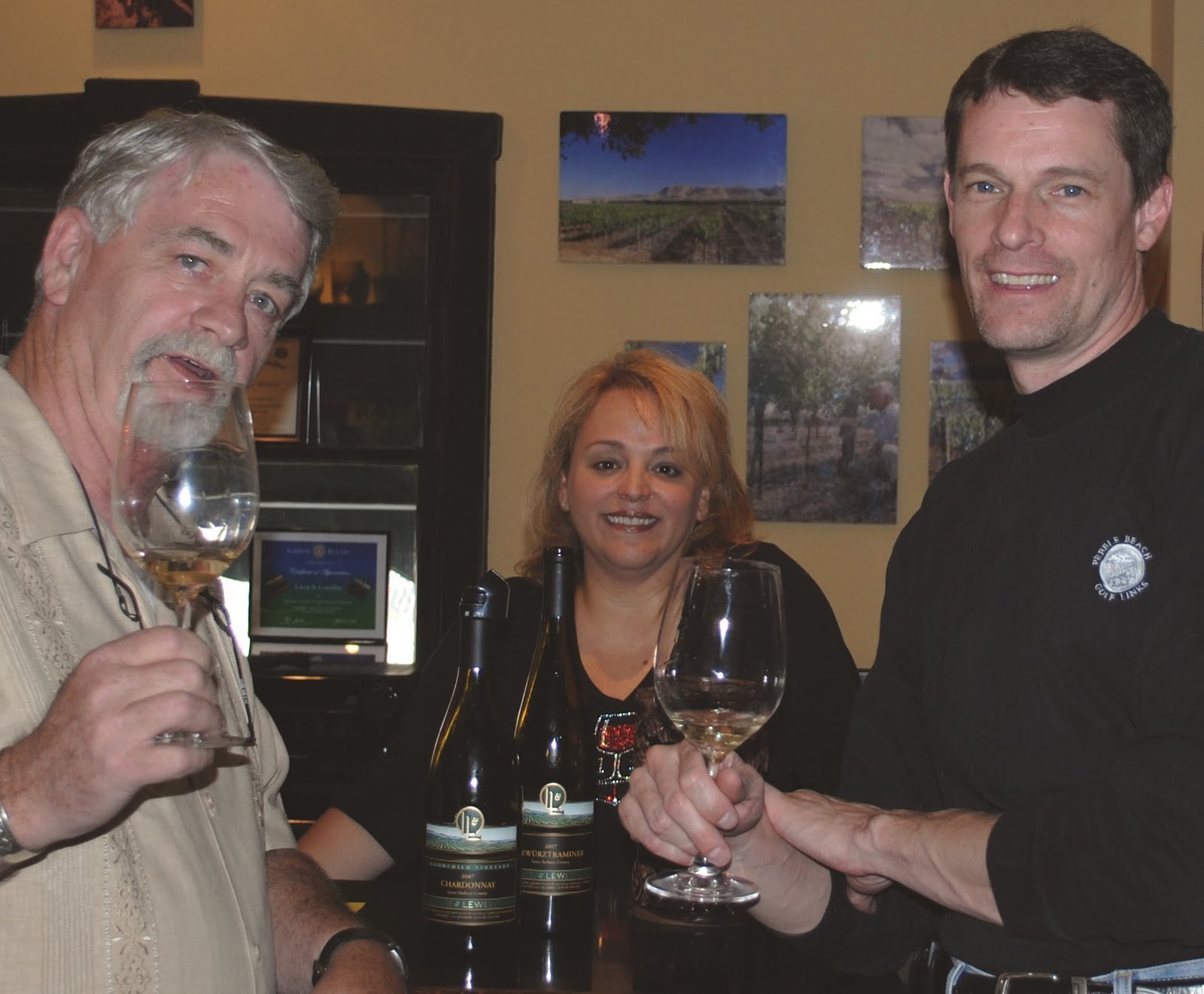
Whites held the day, as well, at the co-owned Lucas & Lewellen Vineyards tasting room just a couple of blocks away. Lemon and orange aromas and flavors were accented with a touch of clover honey in a very respectable late harvest Viognier. We also discovered a pair of excellent aperitifs in two Late Harvest Sauvignon Blancs, both containing a stout 14% residual sugar. The latter, labeled “Sommeil en Barrique” (French for “slept in barrel”) benefited from 12 months aging in French oak barrels. Friend Kent (pictured above with The Wine Guy and our tasting steward) preferred the un-oaked variety while Mrs. Wine Guy and I opted for the greater depth offered by the oaked style. Both went home with us for later enjoyment.

Tasting room visitors may also want to sample the Lucas & Lewellen Silver King Port. It’s an unusual fortified late harvest merlot. It’s fruit forward sweetness makes it nice for serving with chocolate (in fact, the tasting room offers the taste in a chocolate tasting cup). It was a nice dessert offering but probably not the body style that true port aficionados would rave about.

There are a lot of excellent Santa Barbara wines to be found in an area that abounds with great food, good accommodations and great fun but all priced slightly on the high side. Here are a few wines, I’d recommend you sample when you’re in the area:

LaFond Santa Rita Hills Pinot Noir
Stolpman Vineyards Estate Syrah
Foley Rancho Santa Rosa Pinot Noir
Sanford Santa Rita Hills Pinot Noir
Zaca Mesa Vineyards Estate Z-Blanc
Carr Winery Paredon Syrah

There are a number of excellent Syrahs coming out of Santa Barbara County and they have an expression that is somewhat unique to that area. In a blog entitled “Que Sera, Syrah?” (see Roger’s Grapevine archive for blog of 9/30/09), I discussed the ability of this grape to grown in diverse regions and offer great representation of the environment in which it’s grown. There may be a potential for Santa Barbara winemakers to create a signature Syrah for their region.

I have a few more stories to tell in upcoming blogs about our Santa Barbara Wine country visit, including a look at the wines of one of the area’s up and coming young winemakers, David Carr. Please stop back for those and, in the interim, enjoy a great glass of wine.

Saliente!